
Why ArQiver?
ArQiver is a data space platform that behaves like a ledger, combining the properties of a data platform with those of an archiving system.
The transition to ArQiver is at the same time an opportunity to bring information management in order. Network drives, Document Management Systems, SharePoint, Teams, email, legacy systems, dark data and personal storage are not an archive. Information is fragmented, stored multiple times and often without context or metadata.
ArQiver brings this information together, analyzes the content and adds context. It recognizes relationships, reconstructs files and processes, and makes visible what needs to be retained, destroyed or investigated further.
Curious about ArQiver?
Schedule a demoArchiving starts at the source
As soon as information is final, ArQiver can record it immutably, including its context and metadata. But first, it needs to extract the data from its location.
ArQiver stores not only the document, but also its provenance, relationships, context, legal status and retention period. This makes authenticity, reliability and usability verifiable.
The algorithm investigates. The professional decides.
ArQiver scans, analyzes, organizes and classifies millions of documents. AI recognizes patterns, duplicates, files and relevant information. The information professional assesses the results and makes the final decision.
This creates an information management environment in which it is not only visible where information is located, but also what it means, what it belongs to and what may be done with it.

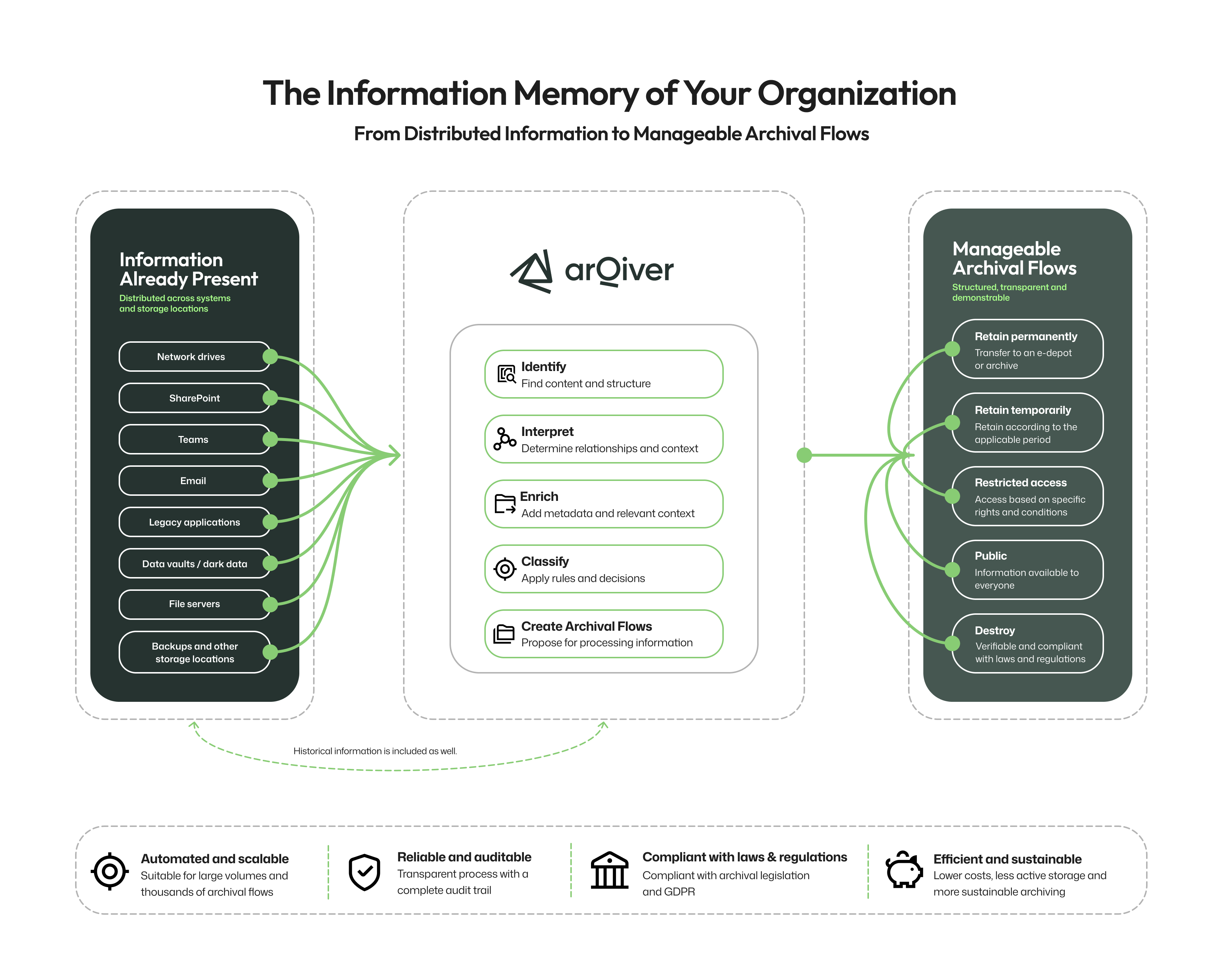
From source to evidence in five steps
Recognize
The AI uses OCR to scan PDF files and images, making them readable and searchable. File name, path, date, owner and available source metadata are included.
Interpret
Document types, versions, files, timelines and process steps are connected to each other. This creates coherence and makes it visible which documents belong together.
Enrich
Context, relationships, legal status, provenance, classifications, quality indicators and retention periods are brought together in a digital passport.
Classify
Rules and quality indicators lead to a substantiated proposal for processing: retain, destroy or investigate further.
Create an Archive Flow
After authorization, the decision is demonstrably executed. When information is final and ready for archiving, the source, context, metadata and decision are recorded immutably.
Decision secured.
These five steps form one auditable trail: from source material to manageable information and ultimately to demonstrable evidence.
Articles
Digital preservation & pre-ingest
ArQiver for digital preservation and pre-ingest
A pragmatic route to extract archive data from legacy systems, make it searchable and prepare it for sustainable archiving.
Read more →Evolving information architecture
From project thinking to evolving information architecture
How organisations design information provision that grows with processes, legislation, data and technology.
Read more →Federated information layer
From data silos to information situational awareness
A practical architecture for overview, governance and controlled sharing across distributed systems.
Read more →Context layer
The information pretending to be software
Much organisational knowledge is hidden inside SQL, ETL, dashboards and application code. What happens when context gets its own place next to data?
Read more →Explore what ArQiver could mean for your team.
Get in touch
Begin with clarity. The rest follows.
Wondering where your organisation fits in?
Let's get in touch.Get in touch
Begin with clarity. The rest follows.
Wondering where your organisation fits in?
Let's get in touch.